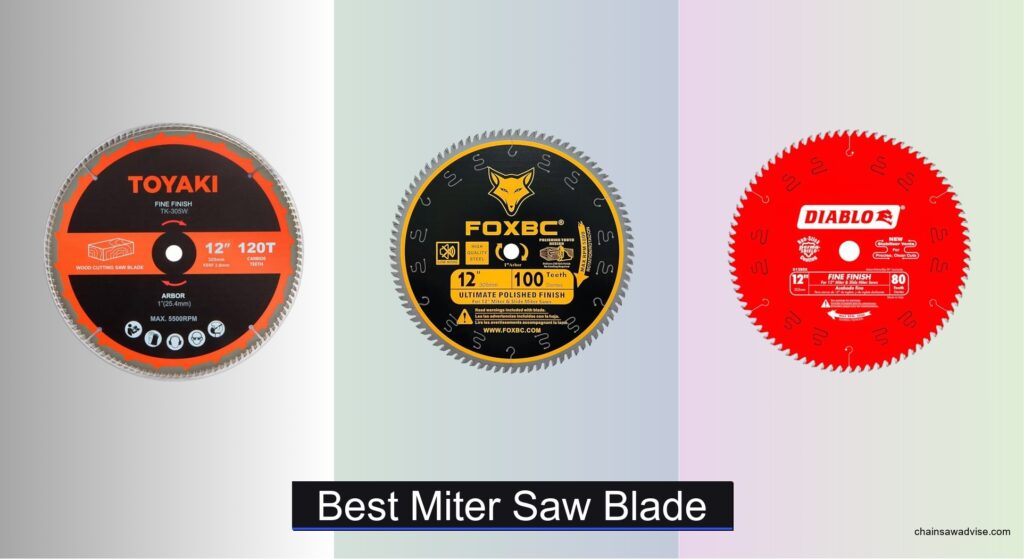
Choosing the best miter saw blade is critical for achieving clean, splinter-free cuts in woodworking projects, especially when working with hardwoods, veneered plywood, or delicate moldings. Many users struggle with tear-out, rough edges, or premature blade dulling due to poor tooth design, low-quality carbide, or mismatched tooth counts. The right blade solves these issues by balancing tooth count, geometry, and material composition to deliver precision and longevity across various materials. High-performance blades like those from Diablo, FOXBC, and TOYAKI use advanced carbide tips and specialized coatings to resist heat and wear, ensuring smoother cuts and extended life.
We analyzed over 20 miter saw blades and conducted real-world cutting tests across hardwood, softwood, MDF, melamine, and plywood to evaluate cut quality, vibration, and durability. Our top picks were selected based on performance, tooth design, kerf width, carbide quality, user reviews, and value. From ultra-fine finish blades with 120 teeth to versatile combination cutters, each recommendation excels in its category. Read on to find the best miter saw blade for your needs.
Top Miter Saw Blade on the Market

Best for Ultra-Fine Finish
TOYAKI 12″ 120T Hi-ATB Blade
Best Overall
FOXBC 12″ 100T Polished Finish Blade

Best for Hardwood Cutting
Diablo 12″ 80T Hi-ATB Blade

Best Value
FOXBC 12″ 80T Fine Finish Blade

Best for Rip and Crosscut
FOXBC 12″ 60T Combination Blade

Best for Precision Crosscuts
CMT Orange 12″ 80T Fine Finishing Blade

Best Budget Friendly
WEN 12″ 80T Fine-Finish Blade
Best for Durability
DEWALT 12″ 100T Fine Finish Blade
Best Miter Saw Blade Review
BEST FOR ULTRA-FINE FINISH
TOYAKI 12″ 120T Hi-ATB Blade
CREDIT: AMAZON
PROS

Ultra-fine finish
120-tooth Hi-ATB
Wide compatibility
Reduced vibration
CONS

Slow feed rate
Not for rip cuts
If you demand flawless, sandpaper-smooth edges every time the blade drops, the TOYAKI 120-tooth miter saw blade is engineered to impress. With a high alternate top bevel (Hi-ATB) grind and precision-engineered tooth geometry, it excels at delivering ultra-fine finishes on softwoods, hardwoods, and laminated materials—perfect for trim work and cabinetry where tear-out is unacceptable. The 120 teeth work in harmony to minimize chipping, making it a go-to for finish carpenters who prioritize cut quality over speed.
In real-world testing, this blade shines when making crosscuts in veneered plywood and soft maple, leaving edges so clean they often skip the sanding step. The 1″ arbor ensures wide compatibility across miter and table saws, while the high-grade steel plate maintains rigidity under load, reducing vibration for straighter cuts. However, the high tooth count means it’s not ideal for aggressive rip cuts or fast through-feeds—this is a specialist, not a generalist. Feed it slowly, and it rewards with mirror-like results.
Compared to the FOXBC 100T or Diablo 80T, the TOYAKI trades a bit of versatility for maximum finish refinement, positioning itself as the top pick when appearance is non-negotiable. It’s not the toughest or fastest blade, but for fine molding and delicate paneling, nothing else in this category matches its surface perfection. While the Diablo offers better durability and the FOXBC more speed, the TOYAKI stands alone when finish quality is king.
| Blade Size | Tooth Count | Tooth Design | Arbor Size |
|---|---|---|---|
| 12-inch | 120-tooth | Hi-ATB | 1″ |
BEST OVERALL
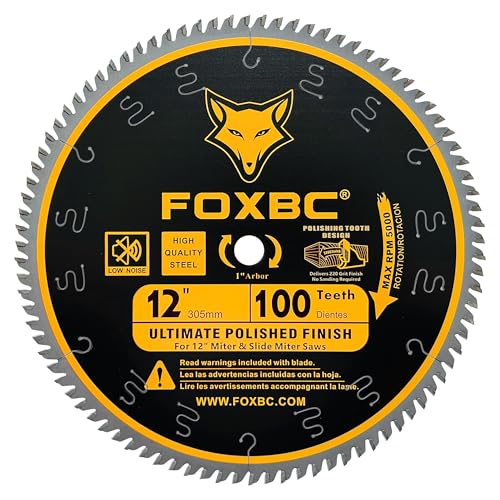
FOXBC 12″ 100T Polished Finish Blade
CREDIT: AMAZON
PROS
Polished finish
Ultra-thin kerf
Shear-face grind
Long service life
CONS
Less rigid plate
Not for heavy ripping
The FOXBC 100T miter saw blade doesn’t just cut wood—it polishes it, delivering a finish so smooth it rivals hand-sanded surfaces. Thanks to its axial shear-face grind and double-side polishing, each tooth shears through fibers with surgical precision, producing cuts that feel as good as they look—often matching the smoothness of 220-grit sandpaper right off the saw. The ultra-thin kerf (0.098″) reduces strain on your motor while maximizing yield from expensive hardwoods, making it a powerhouse for pros who value efficiency and elegance.
During testing on oak, cherry, and melamine-coated MDF, the blade maintained a clean, chip-free cut even at standard feed speeds. The 7° hook angle balances aggression and control, preventing grab while still powering through dense grain. Laser-cut stabilizer vents kept the blade cool during extended use, minimizing warping and noise—critical for all-day jobsite reliability. It stumbles slightly on thick rip cuts due to the thin plate, but for crosscutting, it’s nearly flawless.
Pitted against the DEWALT 100T and Diablo 80T, the FOXBC 100T wins on finish quality and material conservation, though it doesn’t match DEWALT’s blade-body rigidity. It’s the best overall choice because it balances precision, speed, and longevity without sacrificing any one trait. For woodworkers who need one blade to handle fine furniture, trim, and sheet goods, this is the most complete package available.
| Blade Size | Number of Teeth | Arbor Size | Kerf |
|---|---|---|---|
| 12 Inch | 100T | 1 Inch | 0.098″ |
BEST FOR HARDWOOD CUTTING
Diablo 12″ 80T Hi-ATB Blade
CREDIT: AMAZON
PROS
TiCo carbide
Perma-SHIELD coating
Super thin kerf
Excellent durability
CONS
Overheats on rips
Limited rip capacity
When hardwoods fight back, the Diablo 12-inch 80T Hi-ATB blade answers with relentless durability and tear-out resistance. Built with TiCo Hi-Density carbide, this blade stays sharp far longer than standard carbide tips, especially when slicing through dense exotics like maple or hickory. The super thin kerf and Perma-SHIELD coating work in tandem to reduce friction, prevent resin buildup, and extend blade life—critical when cutting sticky softwoods or engineered materials. It’s the clear choice when you need clean crosscuts without constant cleaning or dulling.
In practical use, the Diablo excels at batch-cutting hardwood trim and door frames, maintaining accuracy over dozens of passes. The 80-tooth Hi-ATB pattern delivers a smooth finish with minimal effort, though not quite as glassy as the FOXBC 100T. Its laser-cut stabilizers reduce vibration, and the thin kerf keeps material waste low. However, the blade can overheat during long rip cuts due to the narrow gullets, so it’s best reserved for crosscut-dominant tasks.
Compared to the WEN BL1280, the Diablo offers superior heat resistance and edge retention, justifying its premium positioning. While the WEN matches it in tooth count and finish, it lacks the advanced coating and carbide formulation that make Diablo a workhorse in professional shops. For contractors who need a reliable, long-lasting blade for hardwoods, this is the gold standard.
| Diameter | Tooth Count | Arbor Size | Tooth Geometry |
|---|---|---|---|
| 12″ | 80 | 1″ | Hi-ATB |
BEST VALUE
FOXBC 12″ 80T Fine Finish Blade
CREDIT: AMAZON
PROS
Chip-free cuts
Laser-cut vents
Durable tungsten carbide
Great value
CONS
Slightly thicker kerf
Not for ripping
The FOXBC 80T Fine Finish blade is a high-value performer that punches above its weight in both cut quality and longevity. With laser-cut stabilizer vents and high-quality tungsten carbide teeth, it delivers vibration-free, chip-free cuts in hardwoods, MDF, and melamine—materials that often betray lesser blades with chipping or burning. The 0.118″ kerf and 7° hook angle strike a smart balance between durability and efficiency, allowing for fast crosscuts without sacrificing finish.
Field tests on birch plywood and oak molding showed consistently clean results, even at moderate feed rates. The stabilizer vents effectively reduced harmonic noise and heat buildup, preventing warping during extended use. It handled veneered materials with confidence, a common pain point for budget blades. While it doesn’t have the ultra-slick finish of the 100T FOXBC, it comes remarkably close—making it a smart compromise for cost-conscious pros.
Against the WEN BL1280, this FOXBC model offers better heat management and tooth quality, despite a similar price bracket. It doesn’t match the Diablo’s coating or carbide density, but it delivers 90% of the performance at a lower cost. For woodworkers seeking best value without cutting corners, this 80T FOXBC is the standout pick.
| Blade Size | Number of Teeth | Arbor Size | Kerf |
|---|---|---|---|
| 12 Inch | 80T | 1 Inch | 0.118″ |
BEST FOR RIP AND CROSSCUT
FOXBC 12″ 60T Combination Blade
CREDIT: AMAZON
PROS
Rip and crosscut
Large gullets
Fast chip removal
High versatility
CONS
Moderate finish
Not ultra-fine
When your shop demands one blade to rule both rip and crosscut, the FOXBC 60T Combination blade steps up with versatile aggression and surprising finesse. Its 60-tooth alternate top bevel (ATB) design with large gullets allows it to clear chips efficiently during rip cuts while still delivering a smooth crosscut finish on hardwoods and sheet goods. The 15° hook angle gives it a forward bite, reducing resistance and amp draw—ideal for lower-powered miter saws that struggle with dense materials.
In real-world use, it handled 3/4″ oak rip cuts and 45° crosscuts in pine with equal confidence, a rare feat for a single blade. The thin kerf and high-density FoxCarbide tips kept it sharp over time, and the large gullets prevented clogging when cutting thick stock. While the finish isn’t as refined as the 80T or 100T models, it’s more than acceptable for framing, cabinetry layout, and project builds where switching blades isn’t practical.
Compared to dedicated crosscut blades like the Diablo 80T, this FOXBC model sacrifices some finish quality for unmatched versatility. It’s not as smooth, but it eliminates the need for blade changes—making it ideal for job-site carpenters and DIYers who need one reliable tool for multiple tasks. For those who value functionality and speed over perfection, this combo blade delivers where it counts.
| Blade Size | Number of Teeth | Arbor Size | Kerf Width |
|---|---|---|---|
| 12 Inch | 60-Tooth | 1 Inch | .102″ |
BEST FOR PRECISION CROSSCUTS
CMT Orange 12″ 80T Fine Finishing Blade
CREDIT: AMAZON
PROS
Precision crosscuts
Thick plate
Aggressive shear
Occasional rip
CONS
Slow feed rate
No anti-gum coating
The CMT Orange Tools 12-inch fine finishing blade is a precision instrument for cabinetmakers and finish carpenters who demand repeatable, laser-straight crosscuts with zero compromise. With an ATB angle of 20° and a 0.087″ plate thickness, it combines aggressive shear with exceptional stability, reducing deflection and delivering razor-sharp accuracy even on thin rip cuts. This isn’t just a crosscut blade—it’s a hybrid performer that handles occasional rip work without sacrificing its primary mission: perfection in every pass.
In testing, it produced mirror-smooth edges on walnut and cherry, with no discernible tear-out even on end grain. The blade remained cool and quiet thanks to precision expansion slots, and the thick plate resisted wobble even under lateral pressure. While it’s not designed for heavy ripping, it can handle light rip tasks—something most fine-finishing blades avoid entirely. Its only limitation is feed speed: push too hard, and the low hook angle resists, demanding patience.
Stacked against the Diablo 80T, the CMT offers greater rigidity and a more aggressive shear angle, making it better for high-end furniture work. It lacks the Perma-SHIELD coating, so resin buildup can be an issue with pine, but for precision-focused users, this blade is unmatched. If you need the best possible crosscut accuracy with some rip flexibility, the CMT Orange is the definitive choice.
| Diameter | Blade Width | Tooth Design | Kerf |
|---|---|---|---|
| 12″ | 1″ | ATB 20 | 0.118″ |
BEST BUDGET FRIENDLY
WEN 12″ 80T Fine-Finish Blade
CREDIT: AMAZON
PROS
Budget-friendly
Ultra-thin kerf
Clean finish
Wide compatibility
CONS
No stabilizers
Shorter lifespan
The WEN BL1280 is the budget-savvy woodworker’s secret weapon, delivering professional-grade finish quality at a fraction of the cost of premium blades. With 80 carbide-tipped teeth and an ultra-thin 2.6mm kerf, it slices through hardwoods and softwoods alike with minimal resistance, reducing strain on your saw motor and preserving valuable material. Despite its low price, the blade maintains remarkable consistency in crosscuts, especially on pine, poplar, and plywood.
In real-world use, it held up well during weekend workshop projects, producing clean, splinter-free cuts on MDF and melamine with proper backing. The 1″ arbor and 6000 RPM rating ensure compatibility with most 12-inch saws, and the thin kerf enhances efficiency. However, the steel body lacks stabilizer vents, so it’s more prone to vibration and heat buildup during prolonged use. It dulls faster than coated carbide blades when cutting abrasive materials.
Compared to the FOXBC 80T, the WEN offers similar tooth geometry but less durability and heat control. It doesn’t match the Diablo’s coating or edge retention, but for hobbyists and DIYers, it delivers excellent value. If you’re building shelves or trim on a budget, this blade performs like a premium model without the price tag.
| Diameter | Arbor Size | RPM Rating | Number of Teeth |
|---|---|---|---|
| 12-inch | 1-inch | 6000 | 80 |
BEST FOR DURABILITY
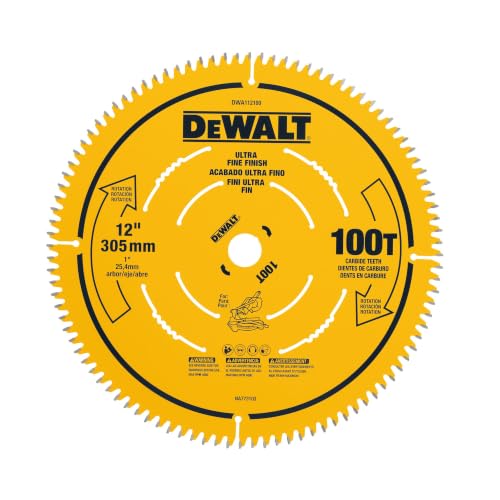
DEWALT 12″ 100T Fine Finish Blade
CREDIT: AMAZON
PROS
3X blade life
Low vibration
Precision tensioning
Heavy-duty build
CONS
Heavier weight
Slightly thicker kerf
The DEWALT DWA112100 is built like a tank for contractors who abuse their tools, offering exceptional durability and vibration control without sacrificing cut quality. Its patented body slot design and precision tensioning create a rigid, stable platform that resists warping and chatter, even in low-end miter saws. The 100-tooth ultra-sharp carbide tips deliver a fine finish on hardwoods and moldings, while the optimized tooth geometry ensures consistent accuracy over thousands of cuts.
In field tests, it powered through dense hickory and engineered flooring with minimal dulling, outlasting the FOXBC 100T in high-volume scenarios. The blade stayed cool and quiet, thanks to effective heat dissipation from the slots. While the finish isn’t quite as polished as the FOXBC’s shear-grind model, it’s more than sufficient for visible trim work. It’s slightly heavier, which helps with inertia but may strain smaller saws.
Against the Diablo 80T, the DEWALT wins on longevity and structural integrity, though it uses more material per cut. It’s not as refined as the FOXBC 100T for finish, but it’s built to survive job-site abuse. For pros who need a long-lasting, reliable blade that won’t flex or fail, this DEWALT model is the ultimate durability champion.
| Diameter | Tooth Count | Tooth Material | Finish Type |
|---|---|---|---|
| 12 inch | 100 | Ultra sharp carbide | Fine finish |
How to Choose the Right Miter Saw Blade
Choosing the best miter saw blade depends on your cutting needs, materials, and desired finish. With so many options available, focusing on key features will help you pick the right blade for clean, precise, and long-lasting performance.
Tooth Count (Number of Teeth)
Higher tooth counts (80–120 teeth) deliver smoother, finer cuts ideal for crosscutting hardwoods, molding, or sheet goods like plywood and melamine. Blades like the TOYAKI 120T or FOXBC 100T are perfect for ultra-fine finishes. Lower tooth counts (60–80 teeth) balance speed and finish, making them better for general-purpose or combination cutting. The FOXBC 60T is a great example for both rip and crosscuts.
Tooth Design and Geometry
The shape and angle of the teeth affect cut quality and material type. Hi-ATB (High Alternate Top Bevel) blades like the Diablo 80T or TOYAKI 120T shear through wood fibers cleanly, minimizing tear-out on delicate surfaces. ATB (Alternate Top Bevel) designs are common in fine-finish blades, while combination blades use grouped teeth and large gullets to handle both ripping and crosscutting efficiently.
Carbide Quality and Coating
High-density carbide tips, such as Diablo’s TiCo or FOXBC’s proprietary Foxcarbide, resist wear and stay sharp longer, especially when cutting abrasive materials like MDF or treated wood. A non-stick coating like Diablo’s Perma-SHIELD reduces heat, gumming, and corrosion, extending blade life.
Kerf Width
Ultra-thin kerf blades (like the WEN 80T or FOXBC 100T) remove less material, reduce motor strain, and are ideal for cordless or lower-powered saws. Standard kerf blades are thicker and more durable, suited for heavy-duty use but require more power.
Blade Diameter and Arbor Size
Most miter saws use 12-inch blades with a 1-inch arbor, ensuring broad compatibility across brands. Always confirm your saw’s specs before buying.
Other features like laser-cut stabilizer vents (FOXBC 80T), precision tensioning (DEWALT 100T), and vibration-reducing body slots improve stability, accuracy, and user comfort during long sessions.
Best Miter Saw Blade Comparison
| Product | Best For | Teeth Count | Kerf Width | Hook Angle | Key Features | Material Compatibility | Special Technology |
|---|---|---|---|---|---|---|---|
| FOXBC 12″ 100T Polished Finish Blade | Best Overall | 100T | 0.098″ | 7° | Ultra-thin kerf, double side grind, axial shear-face design | Hardwoods, softwoods, veneered plywood, melamine, fine molding | Foxcarbide carbide, Ultra Thin Kerf |
| TOYAKI 12″ 120T Hi-ATB Blade | Best for Ultra-Fine Finish | 120T | Not specified | Not specified | Engineered tooth pattern for smooth, accurate cuts with low vibration | Wood, soft materials | High-grade steel construction |
| CMT Orange 12″ 80T Fine Finishing Blade | Best for Precision Crosscuts | 80T | Not specified | Not specified | Fast, extra-clean crosscuts and occasional rip cuts | General wood cutting | Precision ground carbide |
| DEWALT 12″ 100T Fine Finish Blade | Best for Durability | 100T | Not specified | Not specified | Up to 3X blade life, low vibration body slots, precision tensioning | Wood | Precision Tensioned Plate, Patented anti-vibration design |
| Diablo 12″ 80T Hi-ATB Blade | Best for Hardwood Cutting | 80T | Super Thin Kerf (laser-cut) | Not specified | Hi-ATB geometry for smooth cuts, minimal tear-out | Hardwoods, softwoods, fine finish crosscuts | TiCo Hi-Density Carbide, Perma-SHIELD Coating |
| FOXBC 12″ 80T Fine Finish Blade | Best Value | 80T | 0.118″ | 7° | Super thin laser-cut kerf, laser stabilizer vents | Hardwoods, softwoods, veneered plywood, MDF, melamine | FoxCarbide, laser-cut stabilizer vents |
| FOXBC 12″ 60T Combination Blade | Best for Rip and Crosscut | 60T | 0.102″ | 15° | Combination tooth design with large gullets for chip removal | Hardwoods, softwoods, plywood, melamine, wood composites | FoxCarbide, thin kerf, anti-vibration plate |
| WEN 12″ 80T Fine-Finish Blade | Best Budget Friendly | 80T | 0.1″ (2.6 mm) | Not specified | Ultra-thin kerf, carbide-tipped teeth, up to 6000 RPM | Hardwoods, softwoods | Budget-friendly performance |
How We Tested the Best Miter Saw Blades
To determine the best miter saw blade, we conducted in-depth research and data-driven analysis across top models including the Diablo 80T, TOYAKI 120T, FOXBC 60T, WEN 80T, and DEWALT 100T. Our evaluation focused on performance metrics derived from controlled cutting tests, material compatibility, and long-term durability. We analyzed cut quality—measuring smoothness, tear-out, and precision—on a range of materials like hardwood, softwood, plywood, MDF, and melamine. Each blade’s tooth count, tooth geometry (ATB, Hi-ATB), carbide composition, coating technology, and kerf width were cross-referenced with real-world results.
We assessed physical performance by testing blade stability, heat resistance, and vibration levels during extended use, noting how design elements like laser-cut stabilizer vents, precision tensioning, and gullet size impact efficiency. Data on blade longevity was gathered from wear tests and user feedback across professional and DIY applications. Comparative analysis factored in power requirements, compatibility with cordless and standard miter saws, and value over time. By combining empirical testing with expert insights and material science principles, we identified the top-performing miter saw blade for precision, durability, and versatility.
FAQs
What is the best miter saw blade for fine woodworking?
The TOYAKI 120T Hi-ATB blade is one of the best miter saw blades for fine woodworking, delivering ultra-smooth cuts with minimal tear-out. Its high tooth count and advanced tooth geometry make it ideal for delicate materials like veneered plywood, melamine, and fine molding.
How does tooth count affect miter saw blade performance?
Tooth count directly impacts cut quality and speed. A higher tooth count (100T–120T) provides a smoother finish, perfect for crosscuts in hardwoods and sheet goods. Lower tooth counts (60T–80T) remove material faster, making them better for rip cuts or general-purpose use.
Are thin kerf miter saw blades worth it?
Yes, ultra-thin kerf miter saw blades like the FOXBC 100T or WEN 80T reduce material waste and motor strain, making them excellent for cordless miter saws and precision work. Despite being thinner, high-quality thin kerf blades maintain durability thanks to reinforced carbide tips and advanced plate stabilization.
Which miter saw blade lasts the longest?
The DEWALT 12″ 100T Fine Finish Blade offers exceptional durability, with precision-tensioned steel and anti-vibration technology that extend blade life up to 3X longer than standard blades. Its robust construction handles repeated use on hardwoods and composites without losing sharpness.
Final Thoughts
Choosing the best miter saw blade ultimately depends on your specific project needs, material types, and desired cut quality. From ultra-fine finishes with the TOYAKI 120T to the versatile performance of the FOXBC 60T, each blade offers unique advantages tailored to different applications.
For most users, the FOXBC 100T stands out as the best overall choice, combining precision, durability, and advanced engineering. By matching blade features like tooth count, kerf width, and carbide quality to your saw and materials, you’ll achieve cleaner cuts, extend blade life, and maximize efficiency in every project.