If your chainsaw leaves ragged cuts, stalls frequently, or feels dangerously unstable during use, the chain is likely the culprit. Choosing a chainsaw chain that matches your equipment and cutting tasks is essential for safety, efficiency, and protecting your investment. A mismatched chain can increase kickback risk, accelerate wear on your guide bar and sprocket, and make every cut unnecessarily difficult.
This guide walks you through every specification that matters, from pitch and gauge to cutter styles and brand coding systems. You’ll learn exactly how to match your saw, select the right tooth design for your wood type, and avoid common mistakes that lead to poor performance or injury.
Match Core Chain Specifications

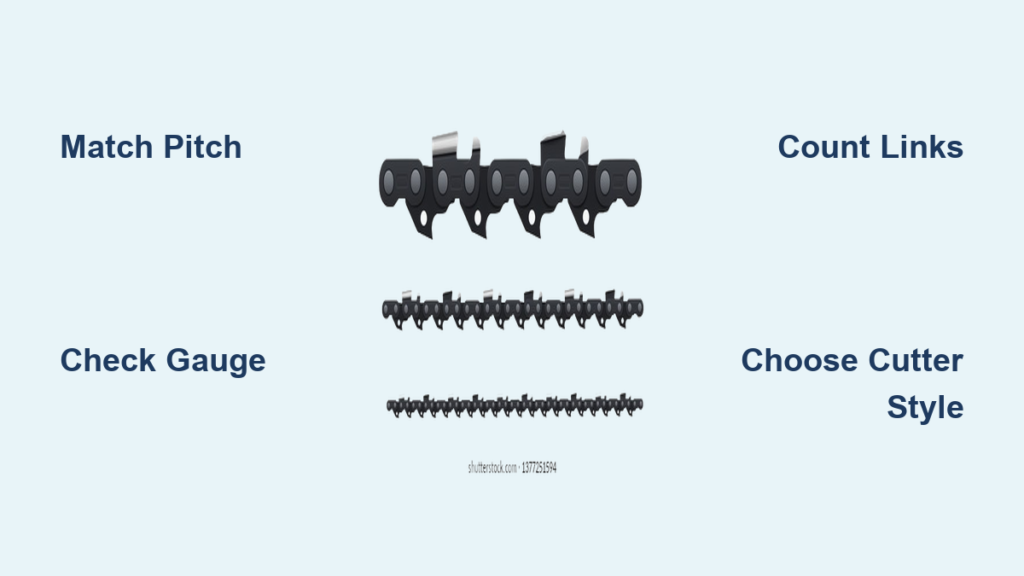
Before evaluating cutting speed or durability, you must verify three fundamental specs. These determine whether the chain will fit and operate safely on your saw.
Identify Chain Pitch
Chain pitch is the distance between three consecutive rivet centers divided by two. It controls how the chain meshes with the drive sprocket and must match both the sprocket and guide bar exactly.
Common pitch sizes include:
- 1/4″ – Mini and battery-powered saws under 38cc
- 3/8″ P (Picco) – Low-profile homeowner chains
- .325″ – Mid-range saws between 35–60cc
- 3/8″ – General-purpose cutting for 50–100cc saws
- .404″ – Professional logging and large timber
⚠️ Critical: 3/8″ and 3/8″ P are not interchangeable. STIHL uses number codes where “3” equals 3/8″ and “6” equals Picco. Use calipers or a pitch gauge to verify before purchasing.
Check Drive Link Gauge
The drive link gauge is the thickness of the chain’s drive links that slide inside the bar groove. It must match the bar’s groove width precisely.
Standard gauges include:
- 0.043″ (1.1 mm) – Small electric and mini saws
- 0.050″ (1.3 mm) – Most common for homeowner saws
- 0.058″ (1.5 mm) – Professional mid-to-large saws
- 0.063″ (1.6 mm) – Heavy-duty industrial use
⚠️ A 0.050″ chain won’t fit a 0.043″ bar and will bind. Conversely, a 0.043″ chain on a 0.050″ bar will rattle and wear prematurely. STIHL codes “3” equals 0.050″ and “5” equals 0.058″.
Count Drive Links for Fit
The number of drive links determines chain length and must match your saw’s loop, which is defined by bar length, sprocket size, and nose design.
To count drive links, remove the chain, mark one link, and count each link until you return to your starting point. Never assume link count by bar length alone. For example, a 16″ bar may require 57, 59, or 60 links depending on chain type and sprocket configuration.
Select Guide Bar Length
The guide bar length determines your maximum cutting depth and should align with your saw’s engine power.
Match Bar to Engine Size
| Engine (cc) | Max Recommended Bar |
|---|---|
| Under 40cc | 16″ or less |
| 40–50cc | 16″–18″ |
| 50–60cc | 18″–20″ |
| Over 60cc | 20″–24″+ |
Using a bar longer than recommended strains the engine, increases vibration, and reduces cutting efficiency. You can safely upgrade one size up if your saw has sufficient power, but always recheck the drive link count.
Choose Cutter Style for Performance
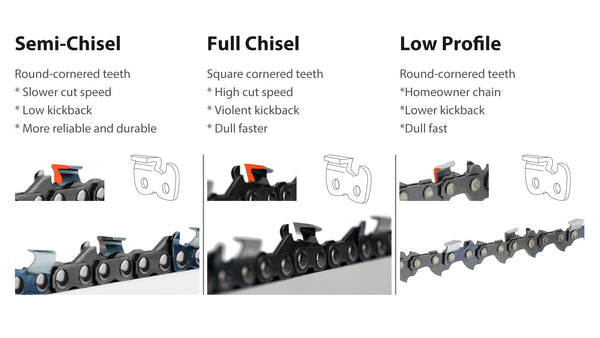
Tooth design directly affects cutting speed, durability, ease of sharpening, and kickback risk. Select based on your experience level and typical wood conditions.
Full Chisel: Fastest Cut
Full chisel chains feature square-cornered teeth that cut aggressively in clean, dry hardwood. They deliver the fastest cutting speed but dull quickly when encountering dirty or frozen wood. These chains carry higher kickback risk and require precise sharpening technique. Best suited for professionals in controlled conditions.
Semi-Chisel: Balanced and Safe
Semi-chisel chains have rounded tooth corners that slow cutting speed somewhat but provide significantly better durability. They handle dirty, frozen, and fibrous wood effectively while reducing kickback risk. Easier to sharpen than full chisel options. Ideal for homeowners and contractors working in varied conditions.
Micro Chisel: Smooth and Durable
Micro chisel chains feature slightly rounded teeth that balance speed with wear resistance. They deliver smoother cuts than full chisel while lasting longer. Lower kickback than full chisel makes them great for general use and firewood processing.
Low-Profile Chains
Low-profile chains like STIHL Picco feature reduced tooth height that lowers vibration and kickback. These are standard on homeowner and battery-powered saws. The PM3 (Picco Micro 3) with humped links represents the safest choice for beginners.
✅ Best for beginners: Low-profile, semi-chisel chains like PM3 offer the best combination of safety and ease of use.
Pick Tooth Material for Durability
The cutting edge material determines how long the chain maintains its sharpness.
Chrome-Tipped Teeth
Chrome-tipped teeth represent the most common option on consumer chains. They hold an edge well in clean wood and sharpen easily with standard file kits. Best for occasional use and firewood cutting.
Tungsten Carbide-Tipped
Tungsten carbide-tipped chains offer extreme wear resistance for dirty, sandy, or frozen wood conditions. Ideal for storm cleanup and utility work. Requires diamond file for sharpening. Never use on metal.
Diamond-Tipped
Diamond-tipped chains are designed for cutting concrete, rock, or metal. They require specialized concrete chainsaws and should never be used on standard wood-cutting saws. Primarily used in rescue operations.
✅ Homeowners: Stick with chrome-tipped chains.
✅ Professionals in dirty conditions: Choose carbide-tipped options.
Optimize Chain Arrangement

The spacing of cutters affects chip clearance, smoothness, and cutting aggression.
Full House: Clean, Smooth Cuts
Full house arrangements feature maximum cutters evenly spaced for precision. Best for milling and finish work. Poor chip clearance in deep cuts makes them less ideal for heavy-duty applications.
Semi-Skip: Balanced Performance
Semi-skip chains alternate one and two tie straps between cutters. Better debris removal than full house while maintaining smoother cutting than full skip. Ideal for hardwood with bars over 24″.
Full Skip: Aggressive, Fast Cutting
Full skip chains have fewer cutters with wide spacing that clears chips quickly in deep cuts. Rough finish and high vibration are drawbacks. Best for felling large trees with bars over 20″. Avoid on shorter bars.
✅ Use full house for precision, semi-skip for heavy work, full skip for rapid clearing.
Use Specialized Chain Types
Certain chains offer specific advantages for particular applications.
Narrow Kerf Chains
Narrow kerf chains remove less wood and reduce friction, allowing longer bars on lower-powered saws. They deliver faster cuts with less strain on the motor. These require narrow kerf guide bars and are not interchangeable with standard bars. Popular options include Husqvarna Pixel and Oregon RakeEdge. Ideal for battery-powered saws and energy efficiency.
Low Kickback Chains
Low kickback chains are designed to reduce dangerous kickback energy. They meet ANSI B175.1 standards and are marked with a green label. Features include humped drive links and reduced cutter height. Examples include STIHL PM3 and Oregon Safety series. Recommended for all non-professional users.
Understand Humped Drive Links
Humped drive links feature a raised profile that reduces kickback and vibration. Identified by a “3” in the model number (such as PM3), these links are standard on low-kickback chains. They improve safety for homeowners and occasional users. Not required for professional plunge cutting where flat links allow better bar tip contact.
✅ Best for occasional users: Humped links enhance control and reduce kickback risk.
Decode Brand-Specific Chains
Manufacturers encode specifications in chain model numbers.
STIHL Chain Codes
STIHL chains use codes like 33RM2 or PM3. The first digit indicates pitch (3 = 3/8″, 6 = Picco). The second digit shows gauge (3 = 0.050″, 5 = 0.058″). Cutter type uses letters: R = Rapid (semi-chisel), M = Picco (low-profile), S = Super (full chisel). Features include M = Micro (semi-chisel), D = Diamond (carbide), H = Semi-skip, F = Full-skip. PM3 decodes to Picco Micro 3: low-profile, semi-chisel, humped links, ideal for homeowners.
Oregon Chain Families
Oregon identifies chains by code numbers like 73, 91 organized by performance and application. Families include general use, professional logging, low-kickback safety, and narrow kerf efficiency. Always check Oregon’s compatibility chart for your specific saw model.
Pre-Stretched Chains
STIHL pre-stretched chains come from the factory with reduced initial elongation. Less frequent tensioning during break-in improves reliability and reduces downtime. Look for “pre-stretched” marking on packaging.
Follow Chain Selection Steps
Use this systematic approach to pick the right chain every time.
Step 1: Verify Compatibility
Check stamped codes on the guide bar or existing chain. Consult your owner’s manual for OEM specifications. Measure pitch, gauge, and count drive links. Confirm bar and sprocket match chain type.
Step 2: Match Cutter to Use Case
| User | Wood Condition | Best Style |
|---|---|---|
| Homeowner | Dry, clean | Semi-chisel, Micro-chisel |
| Homeowner | Mixed/dirty | Semi-chisel, Chamfer-chisel |
| Pro | Hardwood | Full chisel, Semi-skip |
| Pro | Dirty/frozen | Carbide-tipped, Semi-chisel |
| Rescue | Concrete/metal | Diamond-tipped (specialized saw) |
Step 3: Pick Arrangement by Bar Size
Use full house for bars under 20″. Choose semi-skip for bars between 20″ and 24″. Select full skip for bars over 24″ used in clearing.
Step 4: Prioritize Safety
Choose low-kickback chains with ANSI green label. Use humped drive links for reduced kickback. Always wear full PPE including chaps, gloves, helmet, and eye/ear protection.
Step 5: Confirm Fit and Function
The chain should sit flush in the bar groove. Tension properly so the chain pulls freely but doesn’t sag. Verify the drive sprocket matches chain pitch.
Maintain Your Chain
Proper maintenance extends chain life and ensures safer operation.
Essential Tools
Gather cut-resistant gloves, chainsaw file kit with round file and depth gauge, chain breaker or spinner tool, digital calipers, and wire brush or solvent for cleaning.
Maintenance Best Practices
Sharpen your chain regularly since dull chains increase kickback risk. Check tension before each use. Ensure the oiler works and the oil reservoir stays full. Clean the chain after each use to remove sap and debris. Rotate between multiple chains to extend overall life. Replace the drive sprocket when the chain shows wear.
✅ Pro tip: Keep a sharpened spare chain ready to cut downtime in half during long jobs.
Frequently Asked Questions About Choosing a Chainsaw Chain
Can any chainsaw chain fit my saw?
No. Chains must match pitch, gauge, and drive link count exactly. No universal chain exists that fits all saws.
How do I find the right chain for my saw?
Check the stamped codes on your guide bar or existing chain, or consult your owner’s manual for OEM specifications.
Why won’t my chain fit?
Common causes include wrong pitch or gauge, incorrect drive link count, using a standard chain on a narrow kerf bar, or a worn sprocket.
Are chainsaw chains interchangeable?
Only if pitch, gauge, and length match. Cutter style and arrangement can vary even when basic dimensions are identical.
What is the best chain for cutting firewood?
Low-profile semi-chisel chains like STIHL PM3 are best. They offer safety, durability, and easy sharpening.
Which chain reduces kickback risk?
Look for chains with ANSI green label, humped drive links (indicated by “3” in model), low-profile cutters, and semi-chisel or micro-chisel teeth.
Key Takeaways for Choosing the Right Chainsaw Chain
Choosing a chainsaw chain doesn’t require guesswork when you understand the fundamentals. Always match pitch, gauge, and drive link count to your saw first. Select cutter style based on your experience level and typical wood conditions, with semi-chisel or low-profile options being safest for most users. Consider chain arrangement (full house, semi-skip, or full skip) based on your bar length and cutting task. Prioritize low-kickback designs marked with ANSI green labels if you’re not a professional user. Maintain your chain by keeping it sharp, properly tensioned, and adequately lubricated. When in doubt, consult your owner’s manual or a manufacturer-approved dealer to ensure compatibility and safe operation.