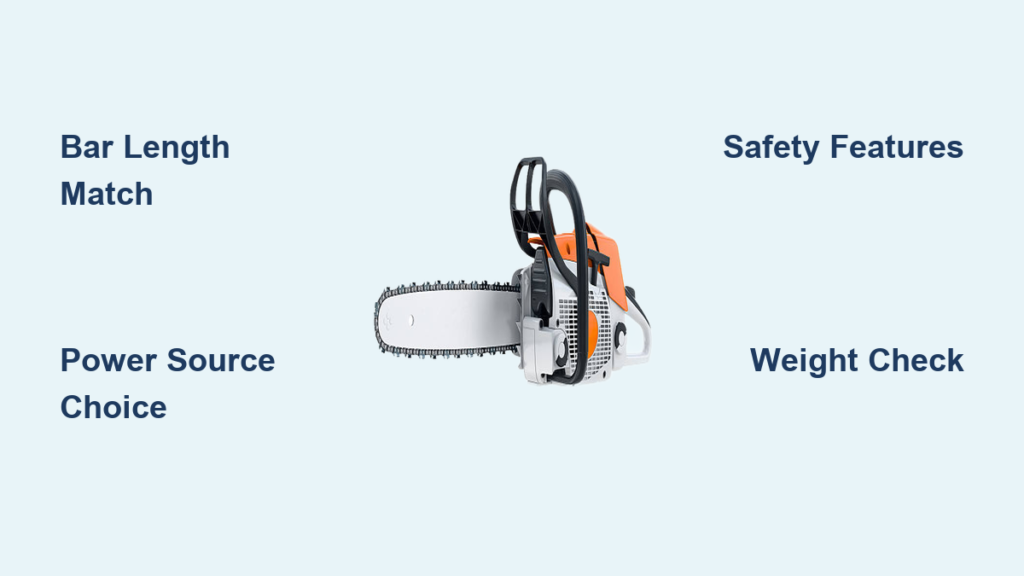
Choosing the right chainsaw can make the difference between a smooth, efficient job and a frustrating, dangerous experience. Whether you’re cutting firewood, clearing storm debris, or maintaining a large property, selecting the best chainsaw means matching the tool to your specific needs, your cutting tasks, physical ability, frequency of use, and environment.
This guide cuts through the confusion, using verified data and real-world performance benchmarks to help you pick the ideal chainsaw. You’ll learn how bar length, power source, safety systems, and ergonomics impact performance, and how to avoid common mistakes that lead to poor results or injury.
Match Power Source to Your Needs

Your choice of power source affects everything: noise, maintenance, runtime, and where you can use the saw. The four main types serve different roles, so pick wisely based on your workload and location.
Gas Chainsaws: Maximum Power and Runtime
Gas-powered chainsaws deliver unmatched performance for heavy-duty tasks. With engine displacements from 30cc to over 90cc, they handle large trees, dense hardwoods, and all-day jobs. Top models cut through 10-inch oak beams faster than most electric saws.
Best for:
• Felling trees over 18 inches in diameter
• Storm cleanup and land clearing
• Professional logging and arborist work
• Remote areas without power access
Pros:
• Unlimited runtime with refueling
• Highest cutting speed and torque
• Works in cold weather (unlike batteries)
Cons:
• Heavy (10 to 20+ lbs) and loud (over 100 dB)
• Requires fuel mixing (50:1 gas-to-oil ratio)
• Regular maintenance required
• Emits carbon monoxide, never run indoors
Top models: STIHL MS-251 C-BE (50.2cc), Husqvarna 455 Ranch, Echo CS-590
Price range: $140 to $600+
Battery Chainsaws: Quiet, Clean, and Easy to Use
Modern battery-powered chainsaws rival small gas models in power. High-end 56V or 80V systems deliver cutting performance close to 45cc gas engines, with zero emissions and instant starts.
Best for:
• Homeowners cutting firewood or limbs
• Noise-sensitive neighborhoods
• Users with other cordless tools (shared battery ecosystems)
• Short to moderate cutting sessions
Pros:
• No fuel mixing or pull-starting
• Quiet (80 to 85 dB) and lightweight
• Low maintenance
• Instant start with push-button or trigger
Cons:
• Limited runtime (30 to 60 minutes per charge)
• Slower in extreme cold
• Battery degrades over time
• Not ideal for full-day professional use
Battery platforms to consider:
• STIHL AP/AK/AS series (not interchangeable)
• Ego 56V (all tools use same battery)
• Ryobi ONE+ (shared across drills, mowers, etc.)
• Greenworks 60V/80V (higher voltage for more power)
Top models: Ego CS1201, STIHL MSA-200, Greenworks CS60L252
Price range: $180 to $330 (kit with battery/charger)
Corded Electric Chainsaws: Budget-Friendly but Limited
Corded electric chainsaws offer consistent power without batteries or gas, but their range is limited by the extension cord.
Best for:
• Light pruning and small limb cutting
• Occasional use near an outlet
• Indoor workshops (with ventilation)
Pros:
• No charging or fuel
• Low noise and zero emissions
• Minimal maintenance
Cons:
• Tethered operation (max 100 ft cord)
• Risk of cutting the cord
• Useless without nearby power
Top brands: Ryobi, Wen, Greenworks
Price range: $40 to $300
Electric Loppers: Safer for Overhead Cuts
For branches above shoulder height, electric loppers are a safer alternative to chainsaws.
Best for:
• Trimming limbs up to 2 inches thick
• Overhead work without kickback risk
• Users uncomfortable with chainsaws
Pros:
• Enclosed cutting jaw reduces injury
• Lightweight and easy to maneuver
• Ideal for elevated pruning
Top brands: Ego, Greenworks, Ryobi
Price range: $70 to $150
Pick the Right Saw for Your Use Case
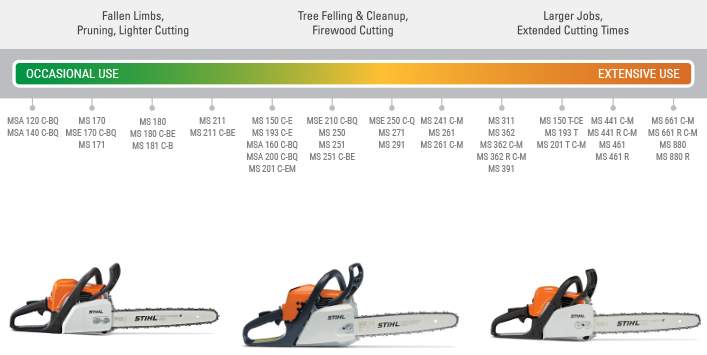
Chainsaws are built for specific roles. Choosing the wrong category leads to frustration, fatigue, or even danger. Match your saw to your job type.
Homeowner Chainsaws: Simple and Safe
Homeowner chainsaws are designed for occasional use: pruning, firewood, and storm cleanup. They prioritize ease of use, light weight, and safety.
Key features:
• Bar length: 14 to 16 inches
• Weight: Under 12 lbs
• Power: Enough for limbs under 12 inches
• Safety: Chain brake, trigger lockout, automatic oiler
Recommended models:
• STIHL MS 182 C-BE
• Husqvarna 130
• Ryobi RY40HPCW03K
• Wen 20754
Farm and Ranch Chainsaws: Built for Weekly Work
If you’re cutting firewood weekly or managing large property, you need a rugged, reliable saw.
Key features:
• Bar length: 18 to 20 inches
• Power: Mid-size gas or commercial battery
• Durability: Enhanced air filtration, anti-vibration
Recommended models:
• STIHL MS-271 / MS-291
• Echo CS-590-18
• Husqvarna 455 Ranch
Professional Chainsaws: All-Day Power and Durability
Arborists, loggers, and tree services need maximum power, comfort, and tool longevity.
Key features:
• Bar length: 20 to 60 inches (up to 59 inches on STIHL 881)
• Engine: 60+cc, magnesium components, fuel injection
• Ergonomics: Heated handles, tool-free adjustments, anti-vibration
Top models:
• STIHL MS-261 (built for 5 to 6 days/week use)
• STIHL 500i (first fuel-injected chainsaw, no carburetor tuning)
• STIHL 881 (largest model, used in timber milling)
Size the Bar to Your Cutting Tasks

Bar length determines what you can cut and how safely you can handle the saw. Use this guide to match bar length to wood diameter.
Bar Length Guide
| Wood Diameter | Recommended Bar Length |
|---|---|
| Under 6 inches (branches) | 10 to 14 inches |
| 6 to 12 inches (firewood, small trees) | 16 to 18 inches |
| Over 12 inches (large logs, felling) | 20+ inches |
Critical rule: The bar must extend 1 to 2 inches beyond the log diameter to complete the cut without binding.
Example: For a 16-inch log, use an 18-inch bar.
Too long? A bar that’s oversized for your tasks increases weight, vibration, and kickback risk.
Too short? You’ll struggle to cut through thick wood, increasing strain and danger.
Match the Saw to Your Physical Ability
Even the best chainsaw is dangerous or ineffective if you can’t control it. Weight and vibration matter significantly.
Weight and Vibration Considerations
• Under 10 to 12 lbs is ideal for older users or those with limited strength.
• Anti-vibration systems reduce fatigue and prevent long-term nerve damage (chainsaw hand).
• Easy-start systems (like STIHL’s Easy-Start spring) reduce pull effort.
• Electric start models eliminate pull cords entirely (available on some gas and battery saws).
Handle and Grip Testing
• Handle spacing should allow full finger wrap with gloves.
• Throttle must be reachable without shifting grip.
• Top-handle saws are for arborists climbing; rear-handle is standard for ground use.
Try before you buy: At a dealer, lean into a cutting stance. Hold the saw in vertical, horizontal, and overhead positions. Assess comfort and control.
Prioritize Safety Features
Safety isn’t optional. Chainsaws cause thousands of injuries yearly, many preventable with proper features and gear.
Essential Safety Systems
| Feature | Why It Matters |
|---|---|
| Chain Brake | Stops chain in milliseconds during kickback. The most important safety feature. |
| Reduced-Kickback Chain | Smaller cutting profile with extra guard links. Lowers injury risk. |
| Chain Catcher | Blocks thrown chain from flying back toward you. |
| Trigger Lockout | Prevents accidental throttle engagement. |
| Automatic Oiler | Prevents chain overheating and breakage. |
| Bucking Spikes | Act as a fulcrum for log cutting. Improves control. |
| Tool-Free Chain Adjuster | Lets you tighten chain quickly without tools. |
| Anti-Vibration System | Reduces fatigue and long-term hand-arm vibration syndrome. |
Never buy a saw without a chain brake. It’s the single greatest safety innovation in chainsaw history.
Mandatory Personal Protective Equipment (PPE)
• Cut-resistant chaps (protect legs from chain contact)
• Helmet with face shield (full facial protection)
• Hearing protection (all saws exceed 85 dB)
• Gloves (improve grip and protect hands)
• Steel-toed boots (protect feet from falling wood)
• Snug-fitting clothing (loose fabric can catch on the chain)
Rule: No PPE equals no cutting. Period.
Understand Chain and Bar Design
The chain and bar determine cutting speed, efficiency, and safety. Choose the right chain type for your experience level and tasks.
Chain Type Comparison
| Chain Type | Best For | Kickback Risk | Speed |
|---|---|---|---|
| Full-Chisel | Professional logging | High | Fastest |
| Semi-Chisel | Mixed hardwoods, general use | Medium | Balanced |
| Skip Chain | Mini-saws, underpowered models | Low | Reduces drag |
| Safety Chain | Homeowners | Lowest | Slower but safer |
Skip chain works like downshifting, reducing engine load and allowing higher RPM in dense wood.
Maintain Depth Gauges
Depth gauges (rakers) control how deeply the chain bites.
• Too low equals aggressive bite, high kickback risk.
• Too high equals slow or no cutting.
File depth gauges every 2 to 3 sharpenings using a gauge tool.
Bar Tips and Lubrication
• Smaller nose equals lower kickback risk.
• Replaceable sprocket nose extends bar life.
• Clean lubrication groove ensures oil flow.
• Safe-T-Tip (Homelite) is a metal shield over tip that prevents contact in kickback zone.
Oil check: Rev engine with bar tip near wood. You should see an oil line on the surface.
Follow a Maintenance Schedule
A well-maintained chainsaw lasts decades. Neglect leads to poor performance and danger.
General Maintenance Checklist
| Task | Frequency |
|---|---|
| Refill bar oil | Before every use |
| Check chain tension | Before every use |
| Sharpen chain | Every 1 to 2 hours of use |
| Rotate bar 180° | After each chain change |
| Clean air filter | Every 5 to 10 hours (gas models) |
| Inspect spark plug | Annually or every 25 to 50 hours |
| Tighten nuts/bolts | After first few uses and periodically |
Gas-Specific Care
• Use fresh 50:1 gas-to-oil mix.
• Add fuel stabilizer if storing over 30 days.
• Clean cooling fins and exhaust regularly.
• Tune carburetor on non-fuel-injected models.
Battery-Specific Care
• Store at 40 to 60% charge in cool, dry place.
• Avoid full discharge.
• Use only manufacturer-approved charger.
• Don’t expose to extreme heat or cold.
Never use used motor oil for bar lubrication. Use commercial bar and chain oil only.
Compare Top Brands and Value
Brand choice affects availability, support, and long-term value.
Brand Overview
| Brand | Power Sources | Best For | Notes |
|---|---|---|---|
| STIHL | Gas, Battery | All levels | Premium quality, dealer-only |
| Husqvarna | Gas, Battery | Homeowner to pro | Sold at Lowe’s, owns Poulan |
| Echo | Gas, Battery | Prosumer | Strong dealer network |
| Ego | Battery | Homeowner | 56V ecosystem, high performance |
| Ryobi | All | Budget homeowner | ONE+ system, Home Depot exclusive |
| Greenworks | Battery, Corded | Budget | 60V/80V, affordable |
| Jonsered | Gas | Premium homeowner | Dealer-only, Scandinavian build |
Best value: Mid-range battery models that match gas performance without the noise or maintenance.
Time Your Purchase for Savings
The best deals come during seasonal transitions.
Best months to buy:
• April to May (pre-summer storm prep)
• September to October (fall yard work and firewood season)
A $90 gas saw can last years with care. But high-end models (STIHL, Husqvarna) offer better durability, ergonomics, and resale value.
Key Takeaways for Choosing Your Chainsaw
The right chainsaw isn’t the most powerful, it’s the one that fits your tasks, strength, and environment. Prioritize safety features, especially a chain brake, match bar length to your wood size, and invest in quality PPE including cut-resistant chaps, helmet, hearing protection, and gloves.
Consider your power source carefully: gas for unlimited runtime and heavy-duty work, battery for convenience and quiet operation, or corded for light occasional tasks. Test models in person when possible, and build around a battery ecosystem if you own other cordless tools. With the right choice and proper care, your chainsaw will serve you reliably for decades.
Frequently Asked Questions About Choosing a Chainsaw
What is the most important factor when choosing a chainsaw?
The most important factor is matching the chainsaw to your specific tasks. Consider the diameter of wood you’ll typically cut, how often you’ll use the saw, and your physical ability to handle the tool. Bar length should extend 1 to 2 inches beyond the wood diameter you’re cutting.
How do I know what size chainsaw I need?
Match bar length to wood diameter: 10 to 14 inches for branches under 6 inches, 16 to 18 inches for 6 to 12 inch wood, and 20+ inches for anything over 12 inches. A bar that’s too long increases weight and kickback risk, while too short makes cutting difficult and dangerous.
Are battery-powered chainsaws powerful enough for firewood cutting?
Yes, modern battery-powered chainsaws are powerful enough for firewood cutting. Top models like the Ego CS1201 (56V) can cut through a 10-inch oak beam over 100 times on a single charge. They’re ideal for homeowners who cut firewood occasionally or for moderate sessions.
What safety features should I look for in a chainsaw?
Look for a chain brake (the most important safety feature), reduced-kickback chain, chain catcher, trigger lockout, automatic oiler, bucking spikes, tool-free chain adjuster, and anti-vibration system. Never buy a saw without a chain brake.
How much should I budget for a good homeowner chainsaw?
Expect to spend $140 to $250 for a quality gas homeowner saw, $180 to $330 for a battery kit with battery and charger, or $40 to $300 for a corded electric model. Factor in an additional $100 to $200 for essential PPE including chaps, helmet, hearing protection, and gloves.