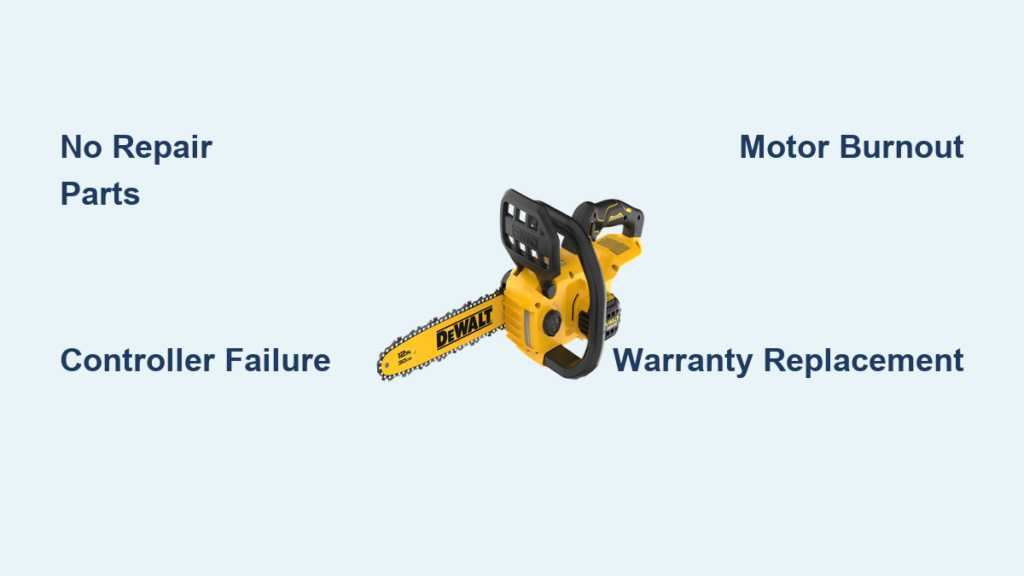
If your DeWalt chainsaw suddenly stops working after just minutes of use, you are not alone. Owners of the DCCS620 20V MAX model report identical failures across multiple units. The saw runs briefly, shuts down unexpectedly, and refuses to restart, even with fully charged batteries. Despite proper maintenance and storage, these chainsaws often fail within a year. This guide covers the root causes, diagnostic steps, and harsh reality of Dewalt chainsaw repair. You will learn what fails, why it cannot be fixed, and how to protect your investment.
Why Your DeWalt DCCS620 Shuts Down After Just Minutes
The Most Common Failure Pattern
The primary symptom reported by DCCS620 owners is abrupt shutdown after minimal use. Some users experience failure after as little as 20 minutes of cumulative runtime. The motor stops, the unit will not restart, and swapping batteries does not help. Some units exhibit intermittent behavior. They run for several seconds, shut down unexpectedly, and occasionally restart after cooling for 5 to 10 minutes. This repeatable pattern suggests a systemic hardware defect, not random failure.
Thermal Cutout or Software Lockout
The intermittent nature points to thermal protection triggering internally. Even if the exterior feels cool, micro-components on the control board may overheat under load. When temperatures spike, the system shuts down through either a physical thermal cutoff or a software-based safety loop. Once triggered, the board may fail to reset, locking the saw in a non-responsive state. This behavior mimics a failing MOSFET or degraded driver IC on the PCB. These components regulate high-current phases in the brushless motor. If one fails or overheats, the entire commutation sequence collapses.
Diagnosing Power Loss in Your DeWalt Chainsaw
Test Battery and Power Flow First
Before assuming electronic failure, rule out simple causes. Use a known-good DeWalt 20V MAX battery such as the DCB205 at 5.0Ah. Plug in and attempt startup with the safety switch engaged. Listen for any click or motor twitch. If nothing happens, test a second battery. If both batteries fail to power the saw, the issue is not the battery. Users consistently confirm that fresh, high-capacity DeWalt batteries do not restore function, ruling out power source failure.
Check All Safety Switches
DeWalt chainsaws have three interlocks. The trigger switch is on the rear handle. The front-handle safety switch engages the chain brake release. The oil-level sensor activates on some models. Use a multimeter to test continuity. Squeeze the trigger and it should show a closed circuit. Disengage the chain brake and the front switch should close. Fill the oil reservoir and the sensor should activate. In most failure cases, all switches test functional. Bypassing them manually still will not start the motor, confirming the fault lies downstream in the controller or motor.
What Actually Fails: Controller Board vs Motor

Controller Board: The Hidden Failure Point
The controller board, tucked inside the handle, is the brain of the chainsaw. It receives battery power, verifies safety interlocks, and sends pulsed current to the brushless motor is three phases. Despite no visible burns or swollen capacitors, internal faults can still cripple it. One key finding is that removing the single board capacitor kills operation entirely, proving it is essential for startup. But its presence does not mean the board is healthy. Latent defects like microfractures in solder joints or weakened transistors can fail under thermal stress, especially during sustained cuts. These flaws are not detectable without advanced tools like thermal imaging or oscilloscopes.
Motor Burnout: Silent and Final
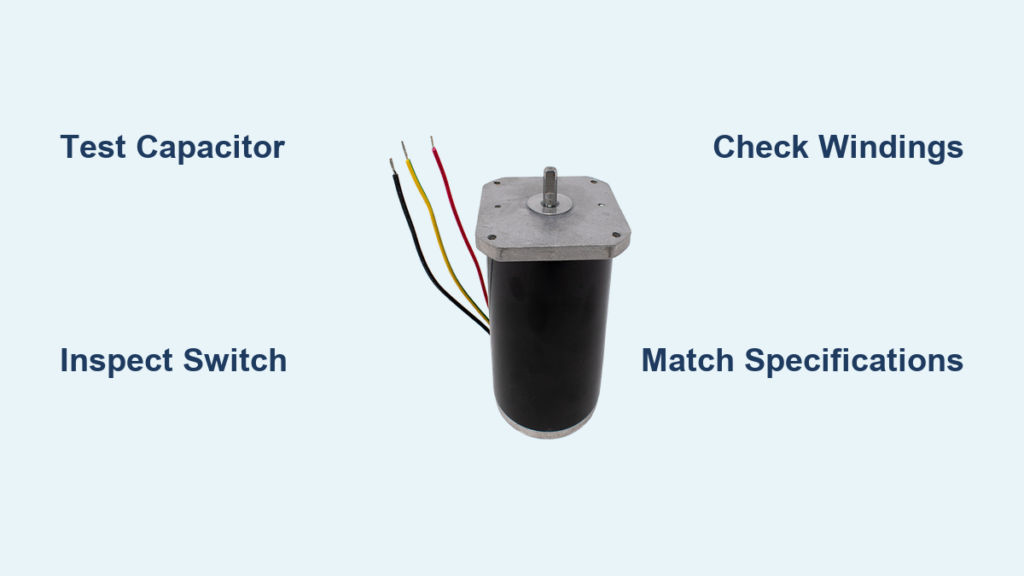
The three-phase brushless motor requires precise electronic timing. If the controller sends erratic signals due to internal failure, phase imbalance can cause instantaneous motor burnout. A failing transistor might send continuous current to one coil, creating a short circuit. Once the motor fails, it is sealed and non-serviceable. Rewinding stators requires industrial equipment. No aftermarket repair services exist. DeWalt sells the motor and controller only as a single motor/controller assembly costing $120 to $180. That is 70 to 90 percent of the price of a new chainsaw.
Why DeWalt Chainsaw Repair Is Nearly Impossible

No Parts, No Schematics, No Fix
You cannot buy a replacement controller board. You cannot order a new motor. DeWalt does not sell these components separately to consumers. The only official fix is replacing the entire motor/controller module, and that requires disassembling the tool body. Third-party repair kits do not exist. Community repair guides have no verified success stories. There are no schematics, no pinouts, and no firmware access. The design is intentionally non-repairable.
Why Even Technicians Cannot Help
Even skilled electronics technicians struggle. Without documentation or test points, replacing suspect MOSFETs or ICs is guesswork. One wrong solder touch can destroy the board permanently. The controller board is a black box with no test points or repair documentation. Latent defects like degraded transistors or microfractures in PCB traces cannot be identified without specialized equipment. For the average user or technician, repair is not feasible.
When Replacement Makes More Sense Than Repair
The Economics Are Clear
Repairing a failed DCCS620 is economically irrational. Paying $150 for a module to fix a $200 tool makes no sense when you can buy new. And if the replacement fails in six months, just like the first two units some users report, your trust in the product vanishes. Service centers will not rebuild the controller. They will quote a module replacement, then you will realize it is cheaper to buy new.
Your Only Real Options
For most owners, the viable options are returning under warranty, recycling via e-waste, or upgrading to a more reliable brand. The hard truth is that if the motor or controller fails, there is no fix. Treat the DCCS620 as a limited-life tool, great while it lasts but disposable when it dies.
Maintaining Your Chainsaw to Prevent Early Failure
Clean Debris From Critical Zones
If your chainsaw still runs, aggressive maintenance is your best defense. Sawdust and oil sludge trap heat, accelerating electronic failure. Clean after every 3 to 5 uses. Use the included hex key to remove the side guard. Vacuum out sawdust from around the sprocket cover and bar groove. Brush away hardened oil and grime. Loosen the bar adjustment and retract the bar fully. Vacuum again deep into the housing. Buildup insulates heat-sensitive electronics. Keeping it clean reduces thermal stress on the controller.
Adjust Chain Tension Properly
A loose chain can jump or bind. An over-tightened chain strains the motor and sprocket. Use the side adjustment nut. Turn counterclockwise to tighten. Stop when the chain is taut but movable by hand. Never let it feel rigid. Always reinstall the protective guard before use. It shields the mechanism and ensures safety switch engagement.
Proper Chain Tension and Oil System Care
The Tension Rule
“Taut but movable by hand — never rigid”
Check chain tension before each use. Over-tightening risks excessive wear, binding, and premature sprocket damage. Always ensure the protective guard is fully reinstalled after adjustment.
Prevent Oil System Clogs
The automatic oiling system keeps the chain lubricated. If left unused for over 30 days, oil hardens and blocks internal channels. This leads to increased friction, chain and bar wear, motor strain, and overheating. To prevent clogs, remove the oil cap and inspect for sludge. Flush with mineral spirits if needed. Use compressed air or a thin wire to clear delivery ports. Vacuum air vents under the handle and near the motor. Use proper bar and chain oil, not motor oil. It is tackier and stays on the chain longer.
Using Your Warranty for a Free Replacement
Act Fast Under 3-Year Coverage
DeWalt offers a 3-year limited warranty on tools. If your DCCS620 fails within that window, act immediately. Locate your proof of purchase. Register the tool at dewalt.com if not done. Visit the Service Center Locator. Bring the saw and battery to an authorized center. Technicians can run diagnostics and often issue goodwill replacements, even if the failure pattern is widespread. Some users report getting new units after multiple failures. DeWalt sometimes honors loyalty despite known design flaws.
Out of Warranty? Replace, Do Not Repair
Once outside warranty, repair is off the table. Service centers will not rebuild the controller. They will quote a module replacement, then you will realize it is cheaper to buy new. Recycle responsibly through DeWalt is e-waste partners or upgrade to a more durable model.
Best Alternatives to DeWalt 20V Chainsaws
Why Milwaukee Outperforms DeWalt
If you rely on cordless chainsaws, Milwaukee is M18 FUEL 12-inch model outperforms DeWalt in real-world durability. Users report no early motor failures, better heat management, longer lifespan, and stronger controller design. Yes, it costs more. But with DeWalt is DCCS620 failing after minimal use, Milwaukee offers better long-term value.
Compare Top Alternatives
| Model | Reliability | Repairability | Verdict |
|---|---|---|---|
| DeWalt DCCS620 | Low | None | Avoid for critical tasks |
| Milwaukee M18 FUEL | High | Limited | Best 20V choice |
| Makita XCU02PT1 | High | Low | Reliable, slightly heavier |
| Ego CS1200E | Moderate | Very Low | Good for light pruning |
For heavy use, consider the DeWalt 60V MAX DCF576. Its larger chassis dissipates heat better, and failures are usually maintenance-related, not electronic.
Key Differences: DCCS620 vs DCF576 Durability

60V Model Lasts Longer
Unlike the 20V model, the 60V DCF576 can last 3 plus years with care. Its brushless system handles load better, and heat buildup is less severe. But neglect leads to oil clogs and motor strain. Maintenance schedule includes cleaning oil ports after every 5 uses, checking chain tension before each use, vacuuming housing and vents monthly, and storing with battery removed and oil reservoir empty if unused for more than 30 days. Preventive care prevents 80 percent of issues.
The Same Repair Limitations Apply
But if electronics fail on the 60V model, it is the same story. No component repair, only full module replacement. So while it is more durable, it is still not truly repairable. The 60V model is worth maintaining. Its failures are usually fixable: clogged oil lines, dirty vents, loose chains. As long as the controller stays cool, it can outlast the 20V version by years.
Final Verdict: Repair or Retire Your DeWalt Chainsaw
Accept the Limitations
The hard truth is that your DeWalt 20V chainsaw is not repairable. If the motor or controller fails, there is no fix. Treat it as a limited-life tool, great while it lasts but disposable when it dies. Your strategy includes maximizing uptime with cleaning and light use, avoiding sustained heavy cuts, keeping proof of purchase, and returning under warranty at first sign of trouble.
Make the Smart Choice
Prioritize preventive maintenance, act fast when failure strikes, and consider Milwaukee or Makita for mission-critical cutting tasks. DeWalt chainsaws deliver strong initial performance and excellent ergonomics, but the 20V DCCS620 is electronic reliability issues make it a risk for long-term users. Repair is not feasible. Warranty replacement is the only real solution. For mission-critical cutting needs, invest in a more reliable brand.
Frequently Asked Questions About Dewalt Chainsaw Repair
Can I repair my DeWalt DCCS620 myself?
No. The DCCS620 is not repairable by end users or most technicians. DeWalt does not sell replacement controller boards or motors. The only official fix is replacing the entire motor/controller assembly at $120 to $180, which exceeds the value of a new tool.
Why does my DeWalt chainsaw shut down after just minutes of use?
The most common cause is controller board failure due to thermal stress. The integrated control board manages power delivery to the brushless motor. Under load, micro-components overheat and trigger a shutdown. This is a documented pattern across multiple DCCS620 units.
Is the battery causing my chainsaw to stop working?
Probably not. Users consistently report that fresh, high-capacity DeWalt batteries do not restore function. The issue is internal to the chainsaw, not the power source. Test with a known-good battery to rule this out before assuming electronic failure.
How long should a DeWalt 20V chainsaw last?
The average functional life is 12 to 18 months with regular use. The primary failure mode is controller board failure. Motor and mechanical components often remain intact when the electronics fail.
Does DeWalt warranty cover this failure?
Yes, within the 3-year limited warranty. Act immediately if failure occurs. Keep your proof of purchase and register the tool online. Some users report getting goodwill replacements even outside warranty for known issue patterns.
Should I buy Milwaukee instead of DeWalt?
For 20V cordless chainsaws, Milwaukee M18 FUEL demonstrates better long-term durability, better heat management, and no reported early motor failures. While more expensive upfront, it offers better long-term value for mission-critical cutting tasks.