You pull the starter cord again, and nothing happens. The air smells like gasoline. Your chainsaw has flooded. This is one of the most common issues with gas-powered models, and knowing how to unflood a chainsaw can save you from being stranded mid-job. Whether you use a Stihl, Husqvarna, Echo, or Poulan, a flooded engine stops you cold—but it doesn’t have to.
In this guide, you’ll learn the fastest recovery methods, how to recognize hydrolock, and the exact steps to get your saw running again. You’ll also discover proven prevention strategies so you never get stuck in the woods with a lifeless engine.
Recognize a Flooded Chainsaw
Before attempting any fix, confirm flooding is the actual problem. Misdiagnosis leads to wasted effort and frustration.
Look for These Signs
The following symptoms strongly indicate a flooded engine. If you experience multiple signs, flooding is likely the culprit.
The engine fails to start despite 10 or more pulls of the starter cord. You notice a strong smell of raw gasoline near the air filter, carburetor, or muffler. The spark plug appears wet or fuel-soaked when inspected. The engine sputters, coughs, or pops during pull attempts but never catches. The starter rope feels stiff or won’t pull at all, which may indicate hydrolock.
If you smell fuel and the engine coughs but won’t fire, you’re likely dealing with a flooded carburetor or cylinder. No spark at all? That’s a different problem requiring ignition system checks.
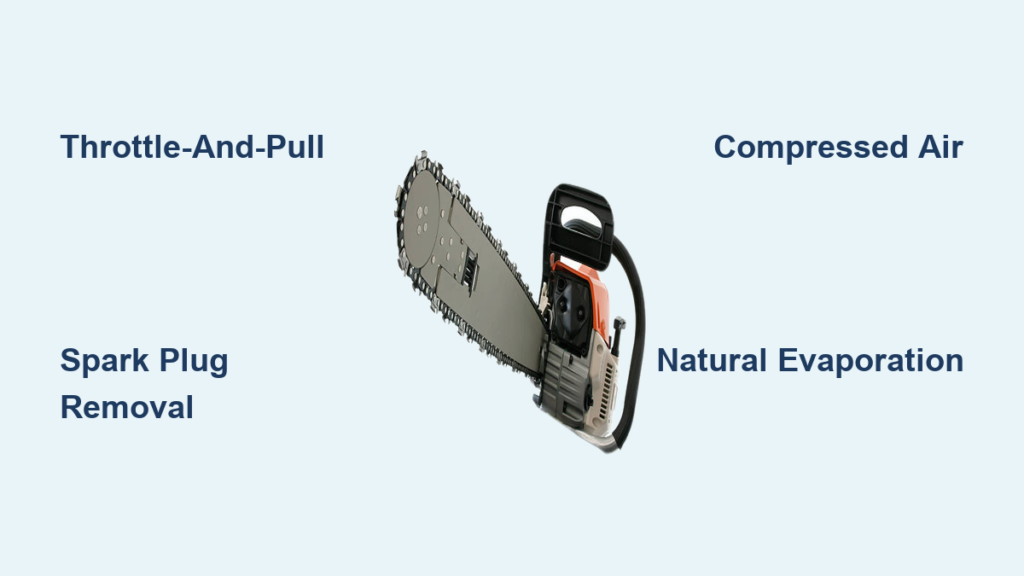
Throttle-and-Pull Method
This is the fastest, most effective fix for mild to moderate flooding. It works on all major brands without any tools.
Why It Works
Holding the throttle wide open disables the fuel enrichment circuit and maximizes airflow through the carburetor. Repeated pulling forces excess fuel out through the exhaust port, gradually restoring a burnable air-fuel mixture.
Step-by-Step Fix
Follow these steps in order for best results.
Engage the chain brake to prevent accidental chain movement. Turn the choke lever to Run or Off. No choke should be active during this process. Ensure the ignition switch is set to ON. Hold the throttle fully open by squeezing the trigger all the way and keeping it there. Stabilize the saw by placing a knee on the body or resting the bar on a log. Pull the starter cord using full, strong, smooth strokes. Do not short-pull or yank gently.
What to Expect
After 10 to 30 pulls, the engine will begin to sputter, pop, or cough as excess fuel is expelled. White or blue smoke may emit from the muffler, which is normal and indicates unburned fuel vapor being cleared. The engine may fire briefly and then stall. Keep pulling until it runs steadily. Once running, allow it to idle for 15 to 60 seconds to stabilize and fully clear residual fuel.
A deliberately flooded Stihl MS-250 started between the 12th and 18th pull using this method. No tools were required.
Spark Plug Removal for Severe Flooding

If the throttle-and-pull method fails, or the starter rope won’t budge, remove the spark plug. This is your go-to method for hydrolock or deep flooding.
Step-by-Step Recovery
Turn the ignition switch to OFF to prevent accidental ignition during service. Remove the spark plug cover using a screwdriver or Allen key to access the plug. Unscrew the spark plug using a 13/16-inch or 21mm socket wrench. Save the spark plug boot.
Inspect the plug to confirm flooding. A wet or fuel-soaked tip confirms flooding. Black deposits indicate chronic rich running. A white tip indicates overheating. Clean or replace the spark plug as needed.
Pull the starter cord 5 to 10 times with the throttle held wide open. This expels fuel from the cylinder via the spark plug hole. Use a rag to catch any fuel spray.
Optionally dry the spark plug by heating the electrode with a lighter until it glows red to burn off moisture. Use caution and perform this only in a safe, fire-free area away from fuel vapors.
Reinstall the spark plug and tighten to 13 to 18 foot-pounds. Snug but not over-tight. Reconnect the boot and restart with choke off, throttle wide open. Pull until it starts.
This method has a near 100% success rate when done correctly, verified by multiple users.
Compressed Air Clearing Method
For workshop or job-site recovery, compressed air clears flooding in seconds.
What You Need
You will need a spark plug wrench, an air compressor with rubber-tipped nozzle, and a clean rag.
How to Do It
Remove the spark plug with ignition off. Insert the air nozzle into the spark plug hole. Apply 30 to 60 PSI for 5 to 10 seconds. This forces fuel out through the exhaust, not the intake. Never blow air toward the carburetor, as this can push fuel into the air filter or fuel tank. Dry and reinstall the spark plug. Attempt restart with choke off and throttle open.
Most hydrolocked engines start within 2 to 4 pulls after air flushing.
Natural Evaporation Technique
No tools available? No rush? Let physics do the work.
How to Do It
Remove the spark plug or air filter cover to allow fuel vapors to escape. Let the chainsaw rest for 15 to 60 minutes in a shaded, ventilated area. During this time, fuel evaporates from the cylinder and carburetor. Reinstall components and try the throttle-and-pull method.
Some users report that returning to a flooded saw after using another chainsaw for a full tank results in effortless starting, likely due to passive evaporation.
Handle Hydrolock Safely

Hydrolock occurs when liquid fuel fills the combustion chamber, preventing the piston from moving. Forcing the starter rope can damage the recoil mechanism, connecting rod, or crankshaft.
Symptoms
The starter rope won’t pull or moves only slightly. There is no sputtering or firing during pull attempts. Fuel may leak from the exhaust or carburetor.
Recovery Steps
Do not force the rope. Remove the spark plug. Pull the starter 5 to 10 times to eject fuel from the cylinder. Dry and reinstall the plug. Restart with choke off and throttle wide open.
Never attempt to crank a hydrolocked engine with the spark plug still installed. The risk of mechanical damage is high.
Prevent Flooding Before It Happens
Most floods are user-caused. Fix your starting routine and avoid the problem entirely.
Correct Cold-Start Sequence
Follow this optimized sequence every time you start a cold engine.
Turn ignition ON. Engage full choke. Prime the engine by pressing the purge bulb 6 to 10 times. Maximum 6 times for Echo and Poulan models. Pull the starter cord 3 to 5 times until the engine farts or fires once. Immediately move the choke to Run. Pull again with slight throttle until the engine starts. Allow the engine to warm up for 10 to 20 seconds before use.
The number one mistake is leaving the choke on too long. The moment the engine burps, switch to Run.
Model-Specific Tips
Different brands have slightly different behaviors. Know your saw.
Stihl
Stihl models like the MS 170, MS 180, MS 250, and MS 361 have aggressive fuel delivery that increases flood risk. They respond well to the throttle-held pull method. The Quick Chain Tensioning system has no impact on unflooding.
Husqvarna
Husqvarna models like the 455 Rancher feature Smart Start, which reduces pull effort and makes repeated cranking easier. Air Injection does not affect unflooding procedures.
Echo and Poulan
These brands are sensitive to over-priming. Limit purge bulb presses to 6 maximum. Due to smaller engine displacement, they may need up to 40 pulls to clear flooding.
Troubleshoot If It Still Won’t Start
Even after unflooding, non-starting points to deeper issues.
Check for Spark
Remove the spark plug and ground it against the cylinder. Pull the starter and look for a bright blue spark. No spark? Check the ignition coil, kill switch wiring, and flywheel magnet.
Inspect Fuel System
Ensure fuel lines are intact and the fuel filter is submerged. Air bubbles indicate a fuel leak. Replace cracked or brittle hoses.
Clear Exhaust Blockage
A clogged spark arrestor screen traps fuel in the engine. Remove the muffler and clean with a wire brush or replace the screen.
Diagnose Carburetor Issues
Persistent flooding may mean a stuck float needle, clogged idle jet, or warped carburetor body. These require professional cleaning or rebuild.
Safety First
Follow these precautions to avoid injury or damage.
Always wear gloves and eye protection when handling fuel-soaked parts. Never use open flame near fuel vapors. Risk of explosion or burns is significant. Turn ignition OFF before spark plug removal. This prevents accidental start. Work in a ventilated area to avoid fuel fume inhalation. Do not force the starter rope if hydrolock is suspected.
One user suffered third-degree burns from using a lighter near the cylinder. Exercise extreme caution.
Frequently Asked Questions About Unflooding a Chainsaw
How long does it take to unflood a chainsaw?
Most floods clear in 3 to 7 minutes using the throttle-and-pull method. With tools, expect 5 to 10 minutes. Severe cases or hydrolock may take slightly longer.
Can I unflood a chainsaw without any tools?
Yes. The throttle-and-pull method requires no tools and resolves approximately 99% of flooding cases. Only severe hydrolock typically requires spark plug removal.
Why does my chainsaw keep flooding?
The most common cause is leaving the choke engaged too long after starting. Other causes include over-priming, a clogged fuel tank vent, a fouled spark plug, or a failing ignition coil.
Is it bad to keep trying to start a flooded chainsaw?
Yes. Continuing to pull with the choke on forces more fuel into the cylinder, making the problem worse. It can also lead to hydrolock, which risks mechanical damage.
What is hydrolock in a chainsaw?
Hydrolock happens when liquid fuel fills the combustion chamber completely. Since fuel is incompressible, the piston cannot move. The starter rope won’t pull or moves only slightly.
Should I replace the spark plug after flooding?
Not necessarily. Clean and dry the spark plug thoroughly. If it shows signs of fouling, damage, or fails to produce a strong blue spark, replace it with an OEM equivalent.
Key Takeaways for Fixing Your Flooded Chainsaw

A flooded chainsaw is a routine operational issue, not a mechanical failure. The throttle-and-pull method clears 99% of floods by holding the throttle wide open and pulling repeatedly to force excess fuel out the exhaust. For severe flooding or hydrolock, remove the spark plug, clear the cylinder by pulling or using compressed air, then reinstall and restart. Prevent flooding by switching the choke to Run the moment the engine burps or fires. If flooding persists, check the fuel tank vent, spark plug condition, ignition coil, and carburetor health. With the right technique, you can get your chainsaw running again in minutes without tools, without a mechanic, and without downtime. Master these steps, and you’ll never be stranded with a flooded engine again.